
Public Digital Object Record

FWX-000015
The Palace
The Palace is a graphical networked chat system originating in the mid-1990s in which users interact within illustrated rooms using graphical avatars. Although official development of the original system has ended, compatible clients, servers, and communities have continued independently.
- Record Number
- FWX-000015
- Release
- Public
- Preservation Status
- Distributed Community Preservation
- Authority
- Forgotten Web Exchange
Visual Reference
Preserved Preview
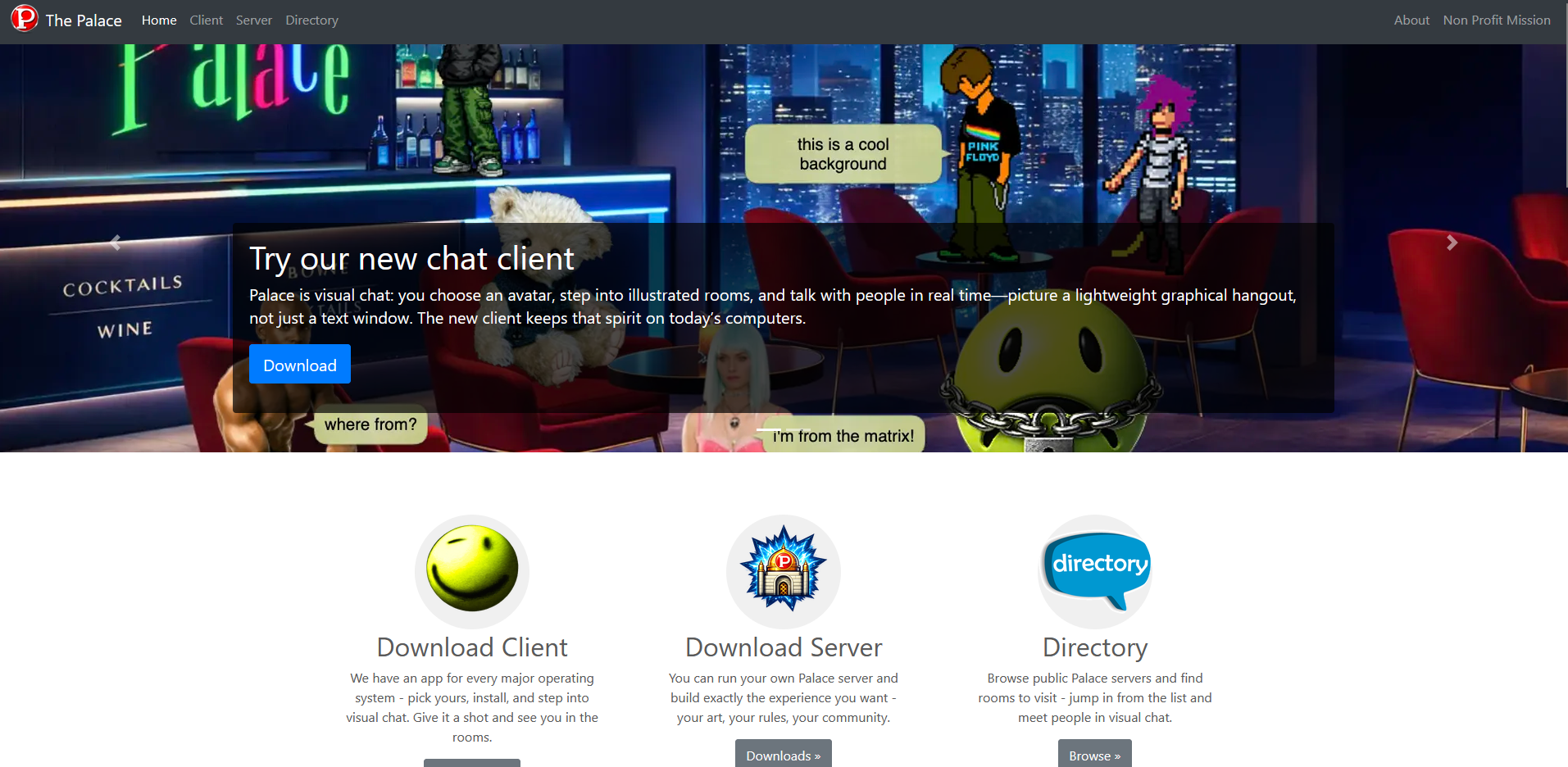
Screenshot captured by the Bureau of Digital Antiquities. Source website
Administrative Record
Object Registration
- Digital Object ID
- FWX-000015
- Object Type
- Graphical Chat System
- Classification
- Public
- Operational Status
- Legacy Ecosystem
- Preservation Status
- Distributed Community Preservation
- Creator
- Jim Bumgardner / Time Warner Interactive
- First Published
- 1995
- Last Verified
- 2026-09-27
- Historical Address
- http://www.thepalace.com/
- Current Address
- Not available — original service discontinued.
Historical Record
Historical Overview
The Palace is a graphical networked chat system originating in the mid-1990s in which users interact within illustrated rooms using graphical avatars. Although official development of the original system has ended, compatible clients, servers, and communities have continued independently.
Preservation Assessment
Current Preservation Status
The Digital Object remains Accessible Through Community-Maintained Implementations at a currently recorded network location.
Periodic Community Review conducted by the Office of Digital Preservation has identified the current integrity status as Distributed Legacy Ecosystem.
Preservation status remains Distributed Community Preservation.
- Observing Office
- Office of Digital Preservation
- Monitoring Programme
- Periodic Community Review
- Integrity Status
- Distributed Legacy Ecosystem
- Accessibility
- Accessible Through Community-Maintained Implementations
Documentation
Narrative Record
Overview
The Palace is a graphical networked communication system developed from a concept created by Jim Bumgardner and released publicly during the mid-1990s.
Unlike text-oriented chat systems, Palace servers present users with graphical rooms in which participants are represented by movable graphical avatars. Users communicate within these shared spaces while interacting with visual environments, other participants, and user-created graphical elements.
The system represents an early form of visually mediated online social space. Its significance lies not solely in the Palace client software or individual servers, but in the combination of client, server, graphical environment, user identity, and community activity required to produce the operational experience.
Official support for the original software eventually ceased. The underlying protocol and software environment nevertheless continued through independent clients, servers, directories, and communities maintained by users and developers.
For catalogue purposes, the Bureau treats The Palace as a distributed networked Digital Object whose historical identity encompasses both the software system and the communities established through it.
Preservation Note
No single surviving Palace server or contemporary client is considered a complete preservation of the historical Palace ecosystem.
Continued operation depends upon independently maintained software, community-operated servers, surviving technical knowledge, and compatibility with modern computing environments.
The Bureau therefore records the object as a distributed community preservation case.
Preservation assessment should distinguish between continued compatibility with the historical Palace environment and reconstruction of individual communities or servers that no longer survive.
Document Control
Publication Details
- Prepared by
- Office of Digital Preservation
- Published through
- Forgotten Web Exchange
- Issuing Authority
- Bureau of Digital Antiquities
- Document Revision
- 1.0
- Record Identifier
- FWX-000015
- Last Verification
- 2026-09-27